TULARE LAKE SUBBASIN PROBATIONARY HEARING DRAFT STAFF REPORT EXECUTIVE SUMMARY
October 2023
The mission of the State Water Resources Control Board (State Water Board) is to preserve, enhance, and restore the quality of California’s water resources and drinking water for the protection of the environment, public health, and all beneficial uses, and to ensure proper water resource allocation and efficient use, for the benefit of present and future generations. The State Water Board is committed to racial equity and working towards a California where race no longer predicts a person’s access to, or quality of, water resources.
In 2014, the state Legislature passed the historic Sustainable Groundwater Management Act (SGMA) that established a new framework for how groundwater would be managed locally at the basin scale to achieve long term sustainability. Local agencies are responsible for the sustainable management of their groundwater basins; however, state agencies are responsible for ensuring local groundwater management achieves SGMA’s goals. SGMA provides the State Water Board and the California Department of Water Resources (DWR) with oversight of groundwater resources to protect them for use by the communities, farms, and environmental resources that depend upon them. The Tulare Lake Subbasin (subbasin) is critically over drafted; on average, water is being pumped out of the basin faster than it is recharged by rain and other sources. Overdraft can cause the land surface to sink, potentially damaging infrastructure.
In addition, overdraft threatens groundwater levels and drinking water quality and could have disparate impacts on communities, many economically disadvantaged, that rely on shallow wells. Due to historic urban segregation, redlining, and the racialized exclusion from public benefits, people of color are often disparately impacted.
The State Water Board recognizes that significant efforts were made by local public agencies in the Tulare Lake Subbasin since the passage of SGMA to form groundwater sustainability agencies (GSAs) and then develop detailed technical and other information supporting the adoption and implementation of a groundwater sustainability plan (GSP) for the subbasin. Despite those efforts, in January of 2022, DWR reviewed the GSP to determine if it met SGMA’s requirements and found it to be incomplete. Following revisions made by the GSAs in the subbasin, DWR reevaluated the GSP in March of 2023, determined it to be inadequate, and referred the subbasin to the State Water Board, as required by SGMA. Consistent with SGMA, the State Water Board may now consider whether to designate the Tulare Lake Subbasin as a “probationary basin,” a term that is used in SGMA to describe the first stage of state intervention.
The goals of this executive summary are to:
- Describe SGMA and the State Water Board’s state intervention process to provide context for the State Water Board’s upcoming Tulare Lake Subbasin Probationary Hearing (Probationary Hearing).
- Briefly describe the demographics, geology, and hydrology of the Tulare Lake Subbasin; and
- Summarize the recommendations by State Water Board staff, which are actions the State Water Board could take at the subbasin Probationary Hearing. These recommendations are to:
- Designate the subbasin probationary. In the short term, this would mean most groundwater pumpers in the basin would need to start measuring their groundwater extractions, report them to the State Water Board, and pay fees. State Water Board staff recommends that most domestic household users (people who use less than two acre feet per year for domestic purposes only) be exempt from reporting extractions and paying fees.
- Identify certain deficiencies (issues with the subbasin’s current groundwater sustainability plan) and potential actions to address them.
- Not exclude any portions of the subbasin from the probationary status.
- Require people who extract more than 500 acre feet per year of groundwater from the subbasin to install and use meters to measure their groundwater extractions.
- Shift the reporting deadline for groundwater extractors from February 1 of each year to December 1.
The complete Draft Tulare Lake Subbasin GSP Assessment Staff Report (Draft Staff Report) provides a full discussion of SGMA and state intervention, background and current conditions in the subbasin, and State Water Board staff’s detailed recommendations to the State Water Board. Section references in this Executive Summary refer to the corresponding section in the Draft Staff Report.
SGMA and State Intervention (Section 2)
SGMA established a new framework for groundwater management in California. SGMA requires local agencies to form GSAs in high and medium priority basins and to develop and implement GSPs. GSAs are responsible for achieving long term sustainable management of their groundwater basins that avoids certain undesirable results within 20 years of implementing their GSPs.
When DWR, in consultation with the State Water Board, deems the GSP or GSPs in a high or medium priority basin inadequate (Wat. Code, § 10734.2, subd.) DWR refers the basin to the State Water Board for a determination as to whether to begin the state intervention process (Wat. Code, § 10735). State intervention is additional to local management and intended to be temporary, and is a twostep process:
- The first step under SGMA is for the State Water Board to determine, through a public process, whether to place the basin on probation.
- In the second step, through a public process, the State Water Board may implement an Interim Plan for the basin. This can only happen if deficiencies are not fixed after at least one year of the basin being on probation.
In determining whether to put a basin on probation, the State Water Board analyzes whether deficiencies identified by DWR were sufficiently addressed prior to the probationary hearing. As part of its analysis, and as reflected in State Water Board Resolution 20210050, Condemning Racism, Xenophobia, Bigotry, and Racial Injustice and Strengthening Commitment to Racial Equity, Diversity, Inclusion, Access and Anti Racism, the State Water Board considers the impacts of basin noncompliance on vulnerable communities, including communities of color.
During a probationary period, GSAs would have time to resolve deficiencies identified in their GSPs and the State Water Board would collect data on groundwater extractions, collect fees from certain groundwater users, and may conduct additional investigations. Importantly, the GSA retains its authorities and responsibilities and must continue to implement its GSP regardless of if the basin is in probation.
Basin Description (Section 3)
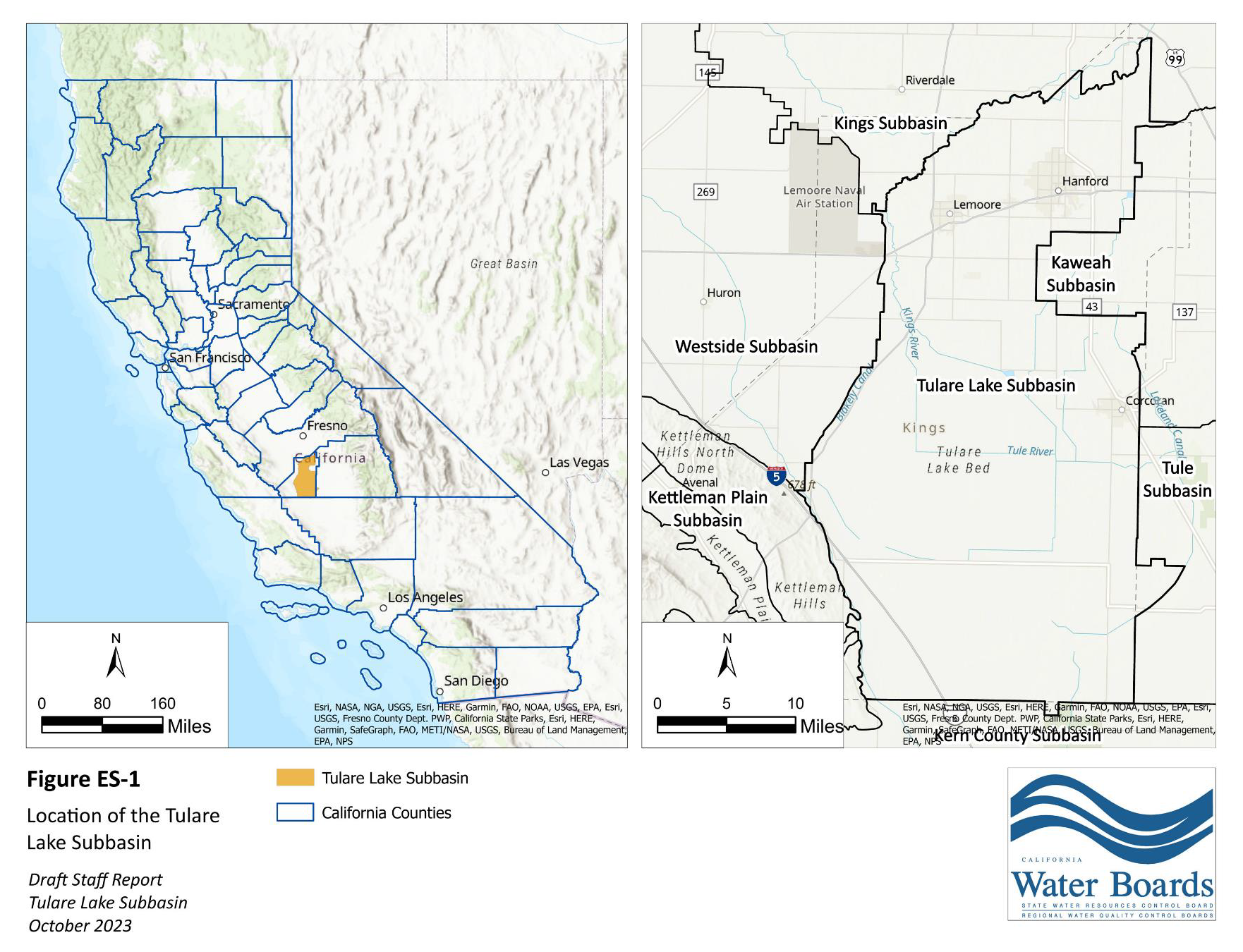
Located in California’s Central Valley in the southern portion of the San Joaquin Valley, the Tulare Lake Subbasin (Figure 1) is bounded to the north by the Kings Subbasin, the northeast by the Kaweah Subbasin, the southeast by the Tule Subbasin, the south by the Kern Subbasin, the southwest by the Kettleman Plain Subbasin, and to the northwest by the Westside Subbasin. The Subbasin covers approximately 535,869 acres or about 837 square miles.
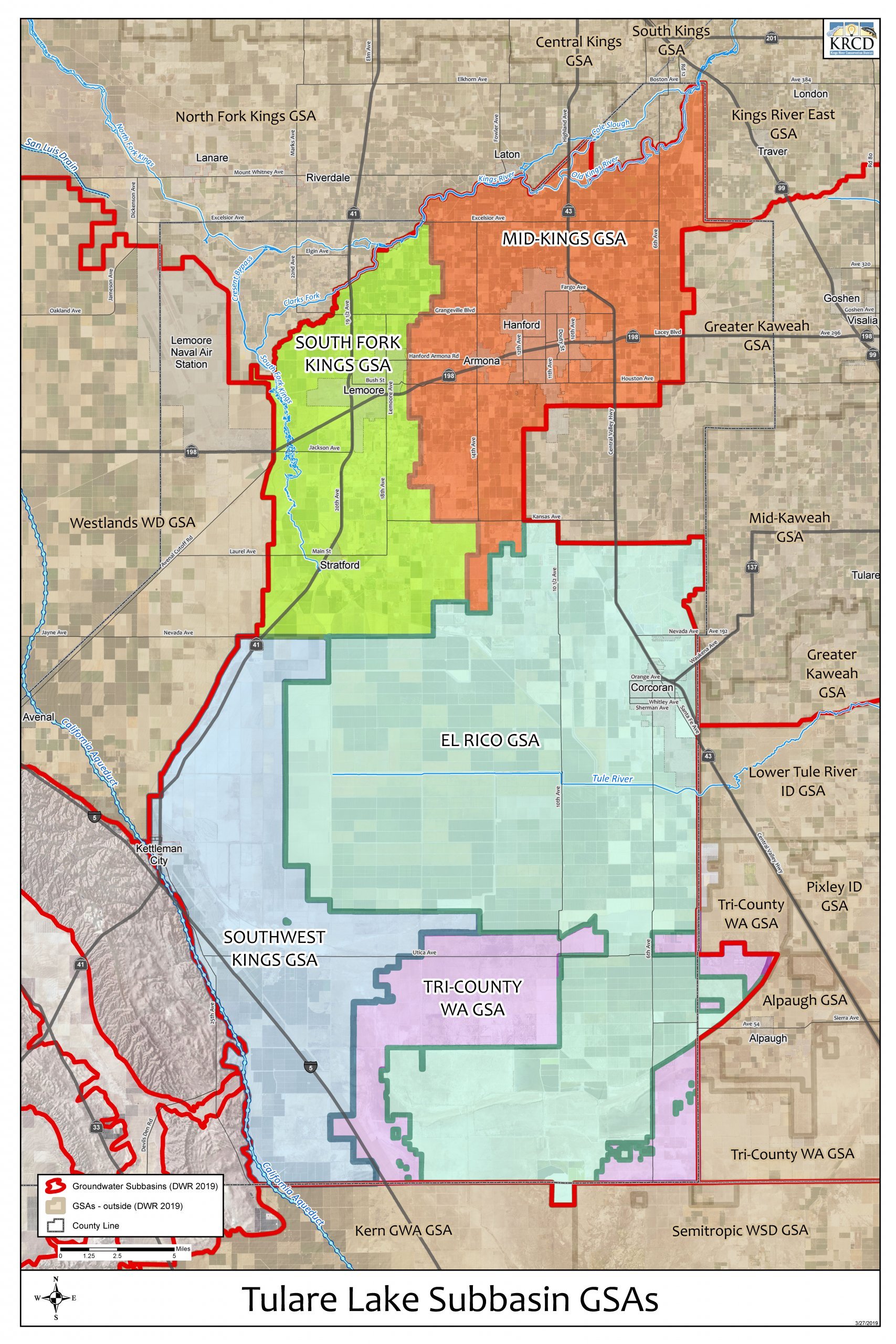
The subbasin contains six localized urban areas, including the cities of Corcoran, Lemoore, Hanford, and the communities of Armona, Home Garden, Stratford, and Kettleman City. According to the Census Block Group Data 2022, the Tulare Lake Subbasin has an estimated population of 145,933 people as of 2022. Most of the land within the subbasin and surrounding areas is used for growing crops and raising livestock. The primary land use designations for urban land are residential, commercial, and industrial. The Tulare Lake Subbasin is currently managed by five GSAs, and the full list of member agencies can be found in Section 3.
Beneficial uses of groundwater in the subbasin include drinking water, agriculture, environment, and oil and gas production. The subbasin contains several aquifers, which are bodies of rock and/or sand and soil that hold groundwater. These aquifers are separated by layers of clay, which slows the movement of water between aquifers and can act as a barrier. The GSP divided the subbasin into three different aquifer zones relevant to groundwater management:
- A-zone: is the shallowest aquifer and is generally about 100 feet deep from the surface.
- B-zone: is below the A-zone and is separated from the other zones by clay layers. This zone is approximately 100 to 700 feet deep.
- C-zone: is below the B-zone and is separated from the B-zone by a thick clay layer that extends underground across much of the San Joaquin Valley. The aquifer below this thick clay layer behaves differently than the shallow aquifers because of physical properties. The C-zone is approximately more than 700 feet deep in the subbasin.
Groundwater is the main source of water for agricultural and urban land uses, but surface water is also available as a resource. The Kings River is the largest and most consistent source of surface water to the subbasin. Currently, both local and imported surface water is delivered through at least 34 conveyance systems (rivers, streams, canals, and diversions) throughout the subbasin (2022 GSP).
For more information on the history, demographics, economy, governance context, groundwater levels, groundwater quality, and subsidence in the subbasin, please refer to Section 3.
Recommendations for State Water Board Action (Section 4)
SGMA states, “in those circumstances where a local groundwater management agency is not managing its groundwater sustainably, the State needs to protect the resource until it is determined that a local groundwater management agency can sustainably manage the groundwater basin or subbasin.” In March 2023, DWR determined the Tulare Lake Subbasin 2022 GSP to be inadequate. State Water Board staff agree with this determination. Now, the State Water Board may determine whether a probationary designation is warranted. State Water Board staff have reviewed the GSP and the DWR staff reports documenting DWR’s review of the GSP.
Staff recommends the State Water Board designate the subbasin as probationary, and note the following:
The GSP will allow substantial impacts to people who rely on domestic wells for drinking, bathing, food preparation, and cleaning, as well as impacts to critical infrastructure such as canals, levees, and the aquifer itself within the subbasin. These undesirable results are likely to occur to an extent in the subbasin that will prevent the subbasin from reaching sustainability by 2040, as required by SGMA. Designating the subbasin probationary is critical for getting the subbasin back on track to achieve sustainability by 2040.
Section 4 of the Draft Staff Report explains State Water Board staff recommendations for a potential probationary designation of the subbasin. These recommendations are described below.
GSP Deficiencies and Potential Actions to Address Deficiencies (Section 4.1)
State Water Board staff have identified specific deficiencies in the Tulare Lake Subbasin 2022 GSP and have outlined potential corrective actions to address those specific deficiencies. The Draft Staff Report also incorporates deficiencies identified by DWR’s determination. Deficiencies that have been identified within the GSP relate to:
- Chronic lowering of groundwater levels with insufficient management criteria.
- Continued land subsidence (sinking).
- Further degradation of groundwater quality.
A summary of the GSP deficiencies and corrective actions are described in further detail below.
To end State Water Board intervention in a groundwater basin, GSAs in that basin must demonstrate their ability and willingness to manage groundwater sustainably and address the issues that caused state intervention to occur. Ultimately, the State Water Board will evaluate any updated and adopted GSP as a whole and will determine whether the GSAs have addressed the deficiencies, whether the GSP is consistent with SGMA, and whether the GSAs are implementing the GSP in a manner that the State Water Board finds will likely achieve sustainability in the subbasin.
Defining and Avoiding Undesirable Results Related to Chronic Lowering of Groundwater Levels (Deficiency GL – Section 4.1.1)
Under SGMA, one piece of achieving the sustainability objective for a basin is avoiding “chronic lowering of groundwater levels indicating a significant and unreasonable depletion of supply if continued over the planning and implementation horizon.” Lowering groundwater levels can cause shallow wells to go dry or reduce their productivity, increase the energy costs of pumping, bring polluted water closer to well screens (the area where groundwater enters a well), or reduce water available for deep rooted plants. Lowering groundwater levels also makes it more difficult to avoid other, related undesirable results caused by groundwater conditions, including land subsidence and depletions of interconnected surface water.
In the Tulare Lake Subbasin, the A-zone and B-zone aquifers are most susceptible to impacts from lowering of groundwater levels, as there are many domestic wells and community water system wells screened in the A and B zones.
DWR concluded that the Tulare Lake Subbasin 2022 GSP does not adequately justify its approach for developing sustainable management criteria for lowering groundwater levels. These are the criteria the GSAs will use to evaluate success in the subbasin. In addition, DWR notes that the sustainable management criteria would likely result in significant and unreasonable impacts to people who rely on shallow wells.
State Water Board staff have built on DWR’s analysis, noting the GSP does not clearly address the likelihood that all the wells in the shallow part of the basin (the A-zone) could go dry based on the GSP’s approach, nor does it identify the wells that could be impacted by the GSP’s current approach. Staff also describe gaps in the GSAs’ proposed well impact mitigation proposal and the feasibility of avoiding chronic lowering of groundwater levels with the projects and management actions proposed in the GSP.
Staff propose potential actions to address the deficiency, including the following:
- Define the undesirable result for the chronic lowering of groundwater levels. Meaningfully engage with users in the subbasin to seek and incorporate feedback on a definition of an undesirable result for chronic lowering of groundwater levels specific to the subbasin and protective of drinking water users.
- Fill data gaps in the subbasin water budget and use the data to develop quantitative criteria that avoid undesirable results.
- Fill data gaps in the groundwater level monitoring network, especially in the A-zone.
- Commit to accessible, comprehensive, and appropriately funded well impact mitigation programs that mitigate for impacts to wells affected by lowering of groundwater levels and degradation of water quality.
- Plan ahead for drought conditions and commit to managing demand.
- Describe the relationship between minimum thresholds (the lowest acceptable level) for each sustainability indicator. Revise groundwater level minimum thresholds as necessary to avoid undesirable results for other sustainability indicators.
Defining and Avoiding Undesirable Results Related to Land Subsidence (Deficiency LS – Section 4.1.2)
Another consideration under SGMA is avoiding “significant and unreasonable land subsidence that substantially interferes with surface land uses.” (Wat. Code, § 10721, subd. (x).) Subsidence is the sinking of land caused by groundwater removal. Land subsidence from excessive groundwater extraction can cause irreversible damages to infrastructure (bridges, roads, pipelines, canals, levees, and buildings) and aqueduct operations. Land subsidence can also diminish the storage capacity of an aquifer, which reduces the available groundwater storage for the future. Importantly, subsidence and its reductions on groundwater storage are often irreversible.
In the Tulare Lake Subbasin, subsidence is primarily caused by the removal of water from the clay layers by groundwater extraction, which causes irreversible compaction and sinking of the land surface. In the subbasin, pumping from the C-zone is likely the primary cause of subsidence.
DWR concluded that the Tulare Lake Subbasin 2022 GSP does not adequately justify its approach for developing sustainable management criteria for subsidence, the criteria that the GSAs will use to evaluate success in the subbasin. DWR also noted that the GSP does not clearly define how it avoids “significant and unreasonable effects on critical infrastructure.” (2022 GSP Inadequate Determination, p. 17.)
State Water Board staff have built on DWR’s analysis, noting that subsidence may substantially increase flooding risks, and have concluded that the 2022 GSP lacks a detailed analysis of the effects of subsidence on all beneficial uses and users within the subbasin. State Water Board staff therefore conclude that significant and unreasonable subsidence may occur under the 2022 GSP.
Potential actions to address the subsidence deficiency include the following:
- Clearly describe the subsidence conditions that would result in an undesirable result for the basin and provide enough detail that associated minimum thresholds can be determined. (Cal. Code Regs., tit. 23, § 354.28.)
- Develop quantitative criteria that avoid undesirable results and conform with agreements with other agencies.
- Consult with flood management agencies and expand the GSP’s analysis of land subsidence impacts on flood infrastructure.
- Plan ahead to avoid significant and unreasonable land subsidence
Degraded Groundwater Quality (Deficiency GWQ – Section 4.1.3)
Another consideration under SGMA is avoiding “significant and unreasonable degraded water quality, including the migration of contaminant plumes that impair water supplies.” (Wat. Code, § 10721, subd. (x).) Degradation of water quality can limit local water supplies and beneficial uses, and SGMA requires GSAs to consider the interests of all beneficial uses and users of groundwater, including municipal well operators and public water systems. (Wat. Code, § 10723.2.)
Water quality degradation that significantly and unreasonably affects the supply or suitability of groundwater for use in drinking water systems is an undesirable result.
In the Tulare Lake Subbasin, water quality degradation could occur in any of the three zones.
DWR concluded the Tulare Lake Subbasin 2022 GSP does not adequately justify its approach for developing sustainable management criteria for Degraded Water Quality, the criteria that the GSAs will use to evaluate success in the subbasin. DWR also recommended that the GSA describe the historic and current groundwater quality conditions within the principal aquifers including the primary groundwater quality constituents (pollutants) identified.
State Water Board staff have built on DWR’s analysis, noting concerns with the monitoring network and monitoring frequency and an absence of projects and management actions identified to avoid undesirable results.
Potential actions to address the water quality sustainable management criteria deficiency include the following:
- Update the definition of an undesirable result to be consistent with GSP Regulations.(The GSP Regulations are set forth in Subchapter 2 of Chapter 1.5 of Division 2 of Title 23 of the California Code of Regulations.)
- Update minimum thresholds to be consistent with GSP Regulations.
- Update measurable objectives to be consistent with GSP Regulations.
- Update the water quality monitoring plan in the 2022 GSP to be consistent with GSP regulations.
- Plan additional sampling when water quality is degraded.
Additional Staff Recommendations for State Water Board Action (Sections 4.24.4)
Exclusions from Probationary Status
The State Water Board must exclude from probation any portions of the basin for which a GSA demonstrates compliance with the sustainability goal. (Wat. Code, § 10735.2, subd. (e).) Staff believe no GSAs in the Tulare Lake Subbasin have demonstrated compliance with the sustainability goal. All five GSAs have adopted and are implementing the same GSP, which DWR has determined to be inadequate. State Water Board staff recommend the State Water Board not exclude any portions of the subbasin from the probationary designation.
Modification to Water Year and Reporting Dates
State Water Board staff do not recommend the State Water Board modify the water year, but staff do recommend modifying the extraction reporting deadline for groundwater extraction reports required pursuant to Water Code section 5202 by changing it from February 1 to December 1.
Requirements for Installation and Use of Measuring Devices
As part of a probationary designation, the State Water Board may require groundwater extraction reporters to install and use measuring devices, such as flow meters, for measuring their groundwater extractions.
State Water Board staff recommend the State Water Board:
- Require people extracting more than two acre feet per year for any reason to report their groundwater extractions.
- Require people extracting more than 500 acre feet per year to install and use meters that meet the requirements of Cal. Code Regs., tit. 23, § 1042 on all their production wells within the subbasin.
- Exclude people who extract two acre feet or less per year for domestic uses only from reporting requirements and paying fees. This exception includes most household users.
Conclusion
Despite significant efforts by GSAs in the Tulare Lake Subbasin, State Water Board staff’s analysis supports DWR’s determination that the Tulare Lake Subbasin 2022 GSP is inadequate. The current plan allows substantial impacts to communities who rely on domestic wells and to critical infrastructure. The Tulare Lake Subbasin is therefore unlikely to achieve sustainability by 2040, as required by SGMA.
Addressing deficiencies related to lowering groundwater levels and groundwater quality degradation is also consistent with the State Water Board’s mission to ensure every Californian has safe and affordable drinking water as reflected in its commitment to the Human Right to Water and administration of the Safe and Affordable Drinking Water Fund.
State Water Board staff recommend probationary status as a critical next step for getting the subbasin back on track to achieve sustainability and protect groundwater resources for the communities, farms, and environmental resources that depend on them.
Figure 1: Location of the Tulare Lake Subbasin